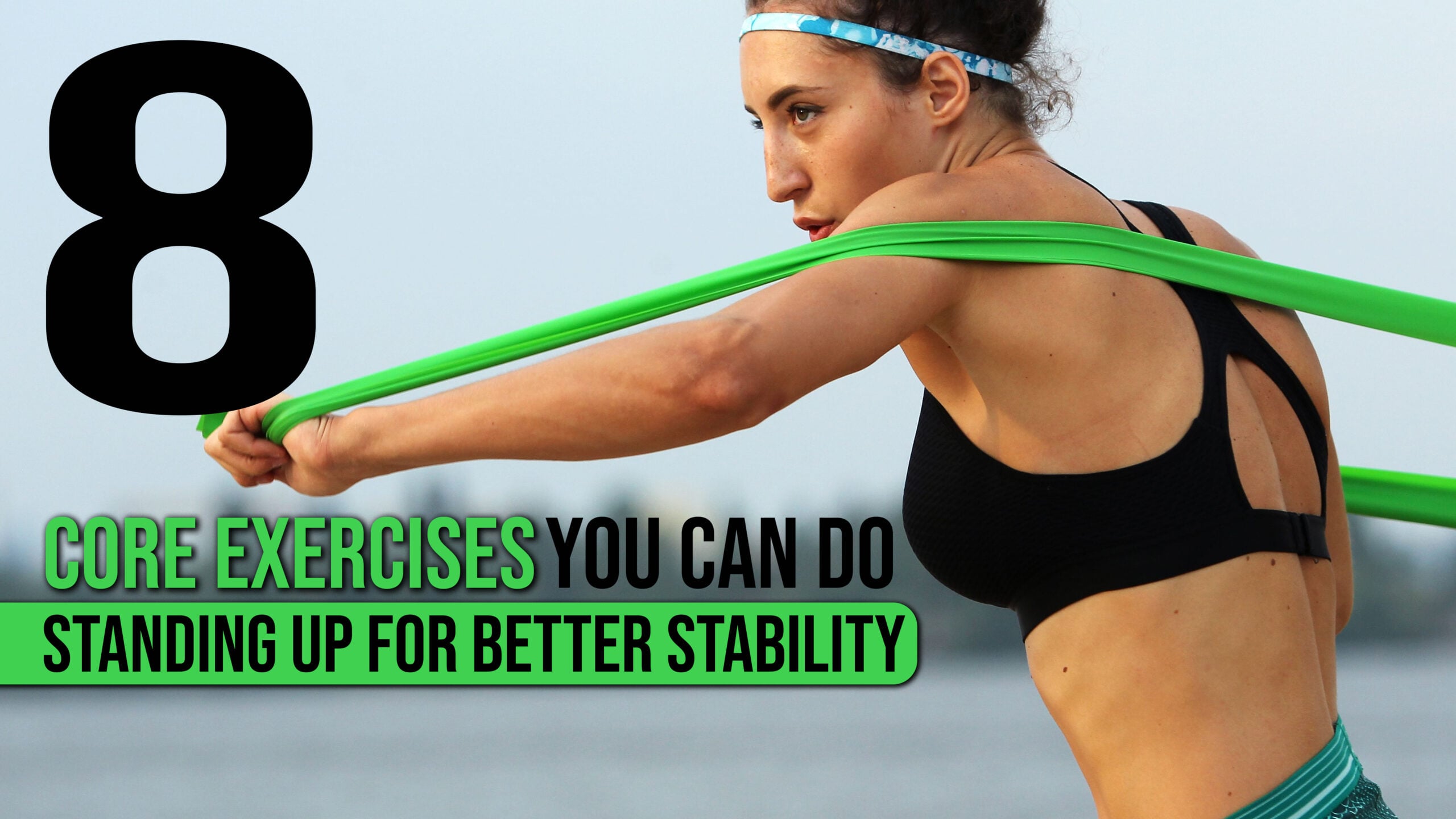
You don’t need to lie down on a mat to build a strong midsection. Standing core exercises like the pallof press, standing woodchop, and single-leg deadlift build the same abdominal strength as floor work, while also training the balance and hip control you use every time you walk, twist, or carry groceries. That combination makes them a smart fit for anyone who wants a core workout without getting down on the floor.
Standing training asks your core to do its real job: keep your spine steady while your arms and legs move. A crunch trains your abs to bend your spine. A standing pallof press trains your abs to resist your spine bending, which is closer to how your core works during a walk, a lift, or a reach overhead.
This approach works whether you’re brand new to core training or already lifting weights and want to round out your routine. Four of the eight moves ahead use only your bodyweight. The other four bring in a dumbbell or kettlebell for extra load and rotational resistance.
Why Train Your Core While Standing?
Standing core work challenges your balance and your abdominal muscles at the same time, which is something floor exercises can’t replicate. When you stand on two feet, or especially one foot, your core has to make constant small adjustments to keep you upright, adding a stability challenge that a plank or sit-up doesn’t offer.
How Do Standing Exercises Build Balance and Stability?
Standing removes the floor as a stable base, so your body has to create that stability on its own. Your core muscles fire to keep your pelvis level and your spine tall, while your legs and feet make small corrections to hold you steady. This is the same skill you use catching yourself on uneven ground or shifting a heavy bag from one hand to the other. Over time, this training carries over into better balance and stability during everyday movement, not just in the gym.
Which Abdominal Muscles Do They Work?
Standing core exercises recruit the same major muscle groups as floor exercises. The rectus abdominis (the muscle along the front of your stomach) handles bending and stabilizing your trunk. The obliques, on the sides of your waist, control twisting and side-bending. The transverse abdominis wraps around your midsection like a corset and is the deep muscle responsible for core engagement and bracing before you lift or move. Standing moves also pull in your hips and lower back, since those areas share the job of supporting an upright, moving spine.
Four Bodyweight Moves to Start With
These four standing ab exercises use nothing but your own bodyweight, making them an easy entry point whether you’re training at home or warming up before a gym session. Each one targets a different core skill, from twisting control to single-leg balance.
1. Standing March with Twist
- Stand tall with your feet hip-width apart and hands behind your head, elbows wide.
- Lift your right knee toward your chest while rotating your left elbow toward it.
- Lower and repeat on the other side.
- Continue alternating for 10 to 12 reps per side.
Form cue: Rotate from your ribcage, not just your arms, so your obliques do the work. Modification: Skip the twist and just march in place if balance feels shaky at first.
2. Standing Side Crunch
- Stand with feet hip-width apart, one hand behind your head, the other resting on your hip.
- Lift your knee out to the side while bringing your elbow down to meet it.
- Lower with control and repeat for 10 to 12 reps, then switch sides.
Form cue: Squeeze the side of your waist at the top instead of yanking with your arm. Modification: Hold onto a wall or chair with your free hand for extra balance support.
3. Standing Bird Dog
- Stand tall, then hinge slightly forward at the hips.
- Extend your right arm forward and your left leg back at the same time.
- Hold for two seconds, keeping your hips square, then return to start.
- Repeat on the other side for 8 to 10 reps per side.
Form cue: Imagine balancing a cup of water on your lower back to keep your hips from tilting. Modification: Keep your extended leg lower to the ground until your balance improves.
4. Single-Leg Deadlift
- Stand on your right leg with a soft bend in the knee.
- Hinge forward at your hips, extending your left leg straight back as your torso lowers toward parallel with the floor.
- Reverse the movement to return to standing.
- Complete 8 to 10 reps, then switch legs.
Form cue: Keep your hips level, like headlights pointing straight ahead the whole time. Modification: Tap your back foot lightly on the floor between reps for added stability.
Four Moves That Add Resistance
Adding a dumbbell or kettlebell to standing core exercises increases the demand on your obliques and deep stabilizers, especially in moves that resist rotation or side-bending. These four moves are common additions to strength training programs and work well once the bodyweight versions feel manageable.
5. Pallof Press
- Anchor a resistance band at chest height, or hold a cable handle, standing sideways to the anchor point.
- Hold the handle at your chest with both hands.
- Press your arms straight out in front of you, resisting the pull toward the anchor.
- Hold for two seconds, then bring your hands back to your chest.
- Complete 10 reps, then turn around and repeat on the other side.
Form cue: During the Pallof Press, keep your torso facing forward the entire time. If you rotate toward the anchor, lighten the resistance. Modification: No band or cable? Loop a long resistance band around a sturdy pole instead.
6. Suitcase Carry
- Hold a dumbbell or kettlebell in one hand, standing tall with shoulders level.
- Walk forward for 20 to 30 steps without letting your torso lean toward the weight.
- Set the weight down, rest, and repeat on the other side.
Form cue: Picture a string pulling the crown of your head toward the ceiling to keep your spine tall. Modification: Start with a lighter weight and shorter distance until your obliques adapt.
7. Standing Woodchop
- Hold a dumbbell with both hands at your left hip.
- Rotate your torso and pull the weight up and across your body to above your right shoulder.
- Control the weight back down to your left hip.
- Complete 10 to 12 reps, then switch sides.
Form cue: Pivot your back foot as you rotate so the movement comes from your hips and core, not just your arms. Modification: Use a lighter weight or no weight at all while you learn the rotation pattern.
8. Offset-Loaded Squat
- Hold one dumbbell or kettlebell at chest height in both hands, or one dumbbell in a single hand at your shoulder.
- Perform a standard squat, keeping your torso upright.
- Complete 10 to 12 reps.
Form cue: Resist the urge to lean toward the loaded side. Your core has to work harder to keep you centered. Modification: Hold the weight with both hands at your chest instead of on one side until you build control.
How to Put the Eight Moves Into a Workout
You get the most out of these eight moves by bracing correctly before each rep and building them into a short, repeatable routine. Bracing means tightening your core gently, as if preparing for a light tap to the stomach, before you move.
How Should You Brace and Adjust Each Move?
Brace your core before you start any rep, not during it. Take a breath in, tighten your stomach and lower back muscles, then move while holding that tension. Exhale as you complete the hardest part of the movement, like the press in a pallof press or the lift in a single-leg deadlift.
Adjust the difficulty by changing your base of support before you change the weight. Standing with feet wider apart is more stable than a narrow stance, and holding onto a wall is more stable than standing free. Progress by narrowing your stance or removing support once a move feels controlled, not shaky.
Standing core exercises pair well with floor-based work like dead bugs, which are useful for teaching the abdominal bracing pattern in a more stable position before you add standing balance challenges. If you have back pain, standing ab exercises can be a comfortable option since they avoid spinal flexion, but they aren’t a treatment for existing back conditions and shouldn’t replace guidance from a physical therapist or doctor if pain is ongoing.
What Is a Simple Standing Core Workout Plan?
A basic standing ab workout takes about 15 to 20 minutes, two to three times a week.
| Exercise | Sets | Reps/Time | Rest |
|---|---|---|---|
| Standing March with Twist | 2 | 10-12 per side | 30 sec |
| Standing Side Crunch | 2 | 10-12 per side | 30 sec |
| Standing Bird Dog | 2 | 8-10 per side | 30 sec |
| Single-Leg Deadlift | 2 | 8-10 per side | 30 sec |
| Pallof Press | 2 | 10 per side | 45 sec |
| Suitcase Carry | 2 | 20-30 steps per side | 45 sec |
| Standing Woodchop | 2 | 10-12 per side | 45 sec |
| Offset-Loaded Squat | 2 | 10-12 | 45 sec |
Beginners can start with the four bodyweight moves alone and add the resistance-based moves once form feels solid.
Frequently Asked Questions
Can beginners do standing ab exercises without equipment?
Yes. The standing march with twist, standing side crunch, standing bird dog, and single-leg deadlift all use bodyweight only. These four moves are a solid starting point before adding dumbbells or kettlebells.
How often should you do a standing core workout?
Two to three times a week works well for most people, with a rest day between sessions. This gives your core muscles time to recover while still building strength consistently.
Are standing core exercises suitable if you have back pain?
Standing ab exercises avoid spinal flexion, so many people with mild back discomfort find them more comfortable than floor crunches. They are not a treatment for back pain, and anyone with ongoing or severe pain should check with a doctor or physical therapist before starting a new routine.
Can standing ab exercises give you a flat stomach?
Standing ab exercises strengthen and tone your core muscles, but they do not target belly fat specifically. Visible changes in your midsection depend on overall body fat, which is influenced by diet and total activity, not ab exercises alone.
Should you use dumbbells or kettlebells for standing core exercises?
Either works well; the choice mostly comes down to what feels stable in your hands. Dumbbells are often easier for presses and woodchops, while a kettlebell’s handle can feel more secure for carries like the suitcase carry.
